Monday, May 26, 2008

Road Trip: Old Lincoln, Part 2

Lincoln has been called "one of the last historic yet uncommercialized 19th century towns remaining in the American West."*


Exhibits in the Historical Center, which is run by Lincoln County Heritage Trust, exhibits "explain the role in Lincoln's history of Apaches, Hispanics, Anglo Cowboys, and the black Buffalo Soldiers, and detail the Lincoln County War."*


Note the sign and the rope on the gate (above). I liked the collision of old and new cultures.
Adobe building remains.
There is a self-guided walking tour booklet available at the Historical Center.

*All quotes in this post are from Frommer's Comprehensive Travel Guide: New Mexico, 3rd edition.

Sunday, May 25, 2008

Road Trip: Old Lincoln, New Mexico


The town of Lincoln is in the Valley of the Rio Bonito near the Lincoln National Forest on Route 380. Situated at 5700 feet, it is a living community although its population is only about 150.
Most of the main street through the town of Lincoln, New Mexico is part of the Lincoln State Monument, and is sometimes said to consist of 1000 yards of museums. It shows a community as it was in the 1870's and 1880's, and includes 17 structures and outbuildings built mostly in the Territorial adobe architectural style.

Thursday, May 22, 2008

Color Charting; Another Use for Excel


I saw a wonderful children's sweater design called "Crimson Toadstools" in the book Country Diary Book of Knitting by Annette Mitchell. I made a copy of the photo for my knitting ideas notebook, but returned the borrowed book without making a copy of the pattern. Squinting at the photo gave me a pretty good idea of how the color pattern was laid out, but I didn't want to take a chance with it. I remembered reading a post called My Super-Sophisticated Charting Software in the Wendy Knits blog wherein Wendy reveals that Microsoft Word and Microsoft Excel will both work for charting out designs, and so I began my big color charting adventure.


It turned out to be easy and fun, once I remembered that the cells needed to be resized. Knit stitches are twice as tall as they are wide, something I've only recently paid attention to. (If you want to download knitting-style graph paper, you can get some here). After a bit of fiddling around, I came up with the chart that you see above. Here is what the resulting sweater looks like so far. The actual colors didn't come out so well in the photo--they are more like what is in the color chart.

My Clovis: Flowers in May

The springtime flowers here are amazing. From our many years in New Hampshire, I'm used to a slow-starting spring, but here in Clovis we are right in the middle of the blooming season for roses.

Wednesday, May 21, 2008

Tenderfeet

When I was a little girl I lived in a house near the ocean in San Francisco.

I wore jeans and cowboy boots, a Roy Rogers cowboy shirt, a Dale Evans cowgirl vest, and a Red Ryder cowboy hat. And every morning before I went out to play I strapped on the rhinestone-studded belt and holsters that held my two matching pearl-handled six-shooter cap guns.

One of the highlights of my misplaced-cowgirl childhood was a trip that my family took with some San Francisco friends down to Arizona, where we traveled up into the mountains and stayed on a for-real ranch that belonged to Jimmy and Jerry’s grandpa.

A cowboy who rode a big black horse gave me a pony to ride. The cowboy's name was Rimrock and I named my pony Chauncey. Rimrock said that Chauncey would always be my pony even when I went back to San Francisco and he was still living his pony life in Arizona.
We “helped” the cowboys round up and brand the calves.

That night we ate Cookie’s delicious beans and biscuits on tin plates while sitting around a campfire. Somebody had a harmonica, and somebody else had a guitar, and we all sang. It smelled like mountain air, pine trees, cattle, dust, and the campfire.

After supper, we rolled up in blankets and lay down around the campfire. Just as we were falling asleep, we heard the sound of boots and spurs. It was Jimmy and Jerry’s grandpa and he walked over to a wooden platform that had barbed wire strung around it, climbed up the steps, went through the little gate at the top, closed it, and sat down on the bed that was up there.

We thought about that for a minute. Then someone called out, using his best cowboy talk, “Hey, Jimmy and Jerry’s grandpa, what’re you fixin’ to do up there?”

Jimmy and Jerry’s grandpa took off his for-real cowboy hat and hung it on one of the barbed wire posts. He said, “I’m fixin’ to go to sleep.” We all thought about that some, and then someone else called out, “Well, how come you’re up there on a platform with barbed wire all around and we’re down here on the ground?”

Jimmy and Jerry’s grandpa had set his Winchester rifle on the floor of the platform and was practicing to see how quickly he could grab for it. He paused for a moment and looked down at us and said, “Well, somebody has to protect us from the slitherin’ snakes, and the howlin’ coyotes, and the things that growl in the night.”

We all lay there, wrapped up in our thin blankets down on the ground. We thought about snakes slitherin’, and coyotes howlin’, and the things that growl in the night.

We thought for about two seconds and suddenly everyone rose up hastily from that dusty ground and there was the sound of hurrying footsteps and car doors slamming.

My Aunt Nellie put me to bed in the backseat of someone’s big old Studebaker, and she lay down in the front seat and went right off to sleep. Her snoring somehow sounded to me just like snakes slitherin’, and coyotes howlin’, and the things that growl in the night.

Meanwhile, back in the clearing, the only sound was the crackling of the campfire. If anyone else had been around, they might also have heard Jimmy and Jerry’s grandpa up there on his platform, chuckling to himself, and saying, “Tenderfeet!”


Another example of Jimmy and Jerry's Grandpa's sense of humor


(Photos by my dad)

Tuesday, May 20, 2008

What I Didn't Know About Calf-Roping

A few weeks ago I was lucky enough to have an outdoor chuck wagon breakfast at the same table as Jon Peek, a handsome young cowboy and rodeo professional, who was kind enough to answer all my questions.


I had just watched my first calf roping the day before and was concerned about the welfare of the calves. Jon reassured me that professional ropers have every reason to be sure that the calves are not injured and that they carefully follow all the rules set out by the Professional Rodeo Cowboys Association (PRCA), including the sections that set out more than 60 rules for the care and humane treatment of animals. Anyone who violates these rules is subject to a fine and is at risk for disqualification from competition. According to the PRCA's official website:


Professional rodeo judges, who are responsible for the enforcement of all PRCA rules, believe in these humane regulations and do not hesitate to report violations. Becoming a PRCA judge involves extensive training in the skills needed to evaluate livestock and testing of that knowledge and of the rodeo. PRCA rodeo judges undergo constant training and evaluation to ensure their skills are sharp and that they are enforcing PRCA rules, especially those regarding the care and handling of rodeo livestock. Animal welfare is a major and ongoing initiative of the PRCA. Not only does the association have rules to ensure the proper care and treatment of rodeo livestock, but it also has several veterinary advisory panels and periodically hosts educational seminars for veterinarians and rodeo industry members. To coordinate its animal welfare efforts, the PRCA employs a full-time animal welfare coordinator to oversee internal and public education programs.


Rodeo competitors respect the animals that they work with and they have a serious financial stake in the outcome of their behavior while competing. The total prize pool for the recent Joe's Boot Shop 4th Annual Calf-Roping was $140,000. Jake Hannum, the 2004 Montana's Richest Calf Roping Champion, was awarded $8000. Many of these young rodeo professionals attend 50 to 60 events a year and their reputations in the arena guide their success.

Monday, May 19, 2008

Joe's Boot Shop 4th Annual Calf Roping

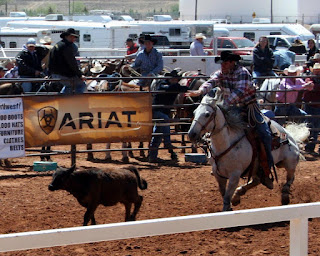
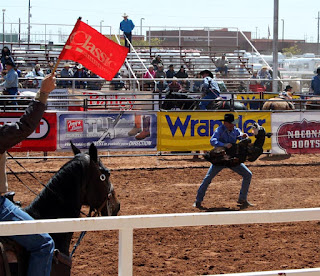
We saw our first calf roping down at the Curry County Fairgrounds on the same weekend as the Chuck Wagon Cook-Off, back on May 2-4. I kind of embarrassed myself by clapping wildly when the first fellow I saw finished tying up his calf. In the middle of my cheering I suddenly realized that no one else up in the stands was paying any attention at all. It was just another calf roping to them; leaving behind for the moment any sympathy I might be having for the calf's feelings, it was an incredible feat of amazing horse and cowboy athletism to me.


When the calf is released, the cowboy takes off after him, lassoes him and leaps off the right-hand side of his horse in an astounding airborne move. The well-trained roping horse holds the rope taut so the calf can’t get away while the cowboy leans over the 200-pound calf and grabs his legs and brings him to the ground. You can click on the above photo and look really carefully to see that the cowboy has a short rope in his teeth called a “piggin' string” that he uses to tie the calf’s feet together.


The whole thing is over in just a few seconds—the fastest times recorded have been in the 5.7 to 6.7 second range! This kind of roping is called “tie-down roping.” There is another kind of calf roping called “team roping” which I hope to see soon because, contrary to all possible predictions, I have become a rodeo fan.

Saturday, May 17, 2008

Anniversary

Today I am celebrating the end of my first year of retirement. It seems to have gone by quickly but when I take stock of what has been accomplished, I am amazed. I ended my last school year early because of foot surgery and while I was still stumping around in a cast we packed up our house in New Hampshire, took a fast trip out to Clovis to find a new house, and then moved cross country. During this past year I have figured out how to "do" retirement; I've found great joy in volunteering at a local school (see the thank you note from my young friend, Anjelica) and in the adult literacy program at the community college. I've joined a wonderful group of women who knit for needy families. My husband and I bought a second house and have rented it to my sister--it is so wonderful to have her close by. I have started swimming several times a week and have spent a lot of time riding through neighborhoods on my bike. I read whenever I want. I meet new people every day.

I've made three of the My Clovis videos now and have posted them on this blog and on YouTube. I love to see who has been watching them, and am amazed that people as far away as Spain, Germany, and the Netherlands have taken a look at my view of this prairie place.

This blog has become an important part of who I am. The written word has become a piece of my daily life and I continually work to improve both my writing and my photography. Because of this blog I see, hear, and experience almost everything in a much more intense way. I love exploring my new part of the world and learning about its history, its places, and its people, then writing about it for my imaginary audience of readers who live far away from this wonderful place. Today's post will be my 156th, something I never could have imagined. When I first started blogging I wondered what I could possibly have to say, but it ended up that I needed to write about prairie dogs, posole, cowboy boots, radio telescopes, charity knitting, adobe houses, curanderas, Harvey Houses, chuck wagons, and tarantulas. Who knew?

I would like to take this opportunity to thank everyone who reads this blog and those who have left comments. You have no idea how much you mean to me.

Friday, May 16, 2008

A Palpable Silence: The VLA

Photo: Matthew L. Abbondanzio. Image courtesy of NRAO/AUI.
The National Radio Astronomy Observatory’s Very Large Array (VLA) is located 50 miles west of Socorro, NM on the Plains of San Agustin. The array consists of twenty-seven 230-ton radio antennas that move together in a Y-shaped configuration to track a single point in space. According to the VLA website, The data from the antennas is combined electronically to give the resolution of an antenna 36km (22 miles) across, with the sensitivity of a dish 130 meters (422 feet) in diameter.
Twilight: Photographer Dave Finley
Image courtesy of NRAO/AUI

From the NRAO’s page on How Radio Telescopes Work: Radio telescopes are used to study naturally occurring radio emission from stars, galaxies, quasars, and other astronomical objects between wavelengths of about 10 meters (30 megahertz [MHz]) and 1 millimeter (300 gigahertz [GHz]).

The Plains of San Agustin are another of New Mexico’s great silent places--places of hot sunshine and incredible thunderstorms. While on the road to the VLA one summer day I kept an eye on an approaching storm off to the left of the road. It swept down a hill just as the car passed by and thunderously arrived to block out the sun. It was as violent a storm as I’ve ever driven through but, when it passed, after a few minutes the plains were sunny and silent once again.

To see a video, NRAO Very Large Array, with a really cute little kid guide: http://www.youtube.com/watch?v=RokSwMS4BiU

~All images courtesy of NRAO/AUI and in compliance with their image use policy

Wednesday, May 14, 2008

A Palpable Silence: Pecos

When you first come to Pecos you are struck by the beauty. Walking up the trail toward the old kiva and the remains of the mission, I always remember the words from the Navajo: I walk with beauty before me. I walk with beauty behind me. I walk with beauty below me. I walk with beauty above me. I walk with beauty around me.


But beyond the beauty and beneath the great palpable silence, you cannot help but be aware of the presence of those who have gone before; those who have lived here in peace, those who came to trade, those who came to enslave, those who sought to overthrow, and those who killed to empower themselves.
As you walk along the trail, a closer look at the trailside rocks and soil shows you a ground littered with pieces of ancient pots. History is overlaid with history here. You stand at the site of an ancient pueblo, two Spanish colonial missions, part of the Santa Fe trail, a Civil War battle, and a 20th century working ranch.


Go down the old ladder into the ancient underground kiva and spend some moments alone with your thoughts and all the swirling fragments of the past. Absorb some of that great silence into yourself and make it your own. Climb back up into the hot sunshine and walk with beauty all around you.

Tuesday, May 13, 2008

A Palpable Silence: La Cueva

Looking toward the Organ Mountains from the Rio Grande

The Organ Mountains hang over Las Cruces like the backdrop for an old cowboy movie. You can drive up to the Dripping Springs Natural Area to experience the mountains close up.

On our first trip there we were drawn by the sound of water, as one always is in the desert, into a small display garden of native species outside the Visitor Center. I located the source of the water, a tiny fountain and, as I leaned closer to look at it, noticed a small sign. It informed me that just as I was drawn to the trickling sound of water so were other inhabitants of the desert, including snakes and lizards, and that I should watch my step on my way out of the garden.

This was just our first introduction to the animal population of this seemingly empty place. There are several miles of trails, and the center has extensive lists of animal sightings that are reported to the ranger there. According to New Mexico Wildlife publication: "Because of water which finds it way to the surface there year-round, Dripping Springs is a desert oasis where unique biotic communities thrive. Any time of year, visitors enjoy excellent viewing of red-tailed hawks and Gambel's quail. There's also a good chance of spotting desert mule deer, coyotes, and rock squirrels. In spring and summer, watch for golden eagles and prairie falcons which occasionally soar overhead. Along the hiking trails, look for black-chinned sparrows, Scott's orioles, canyon wrens, Red-naped sapsuckers, and collared lizards. There are also occasional sightings of mountain lions, of which this area has a viable population. Dripping Springs is also home to a race of the Colorado chipmunk and two threatened species of land snails." We saw an amazing variety of brightly colored lizards and a tarantula's burrow by the side of the trail.

Our destination was La Cueva, a large cave that has been associated with the prehistoric Mogollon culture. It is thought to have been occupied from around 5000 B.C. and has yielded thousands of artifacts. The Apaches used it for a shelter in the 18th and 19th centuries. In the late 1860s, it served as a home to El Ermitano (the hermit), an Italian of noble descent called Giovanni Maria Agostini.

Agostini had perhaps studied for the priesthood in Italy. He spent some time with the Penitentes of Northern New Mexico, who were impressed by his healing powers. He decided to go to La Cueva to live alone and to meditate, a plan that worried friends he had made in Old Mesilla. He and his friends worked out an arrangement to set their minds at ease. Every Friday night he would kindle a fire in front of the cave that they would be able to see from Mesilla, and they would thus be assured of his continuing safety. One Friday evening in 1869, as the story goes, the fire did not appear. When the friends had made their way up to La Cueva, they found El Ermitano dead--face down on the ground with a knife in his back. His murder was never solved.

In spite of its long history, La Cueva is another of those empty New Mexico places with a palpable silence. It's a place to stop in, to be still, and to meditate.

Monday, May 12, 2008

We Are the Ones We've Been Waiting For

A Palpable Silence: Sandia Cave

Up the little trail, cave in the distance

I came across this phrase in a book--a palpable silence--that stopped me right there on the page. There it was, the perfect way to describe what I feel sometimes, in some places, here in New Mexico.

On our very first trip out from New Hampshire to take a look around New Mexico with the idea of living here, we drove up into the Sandia Mountains outside of Albuquerque. About four miles up from Placitas, we saw a smallish sign saying "Sandia Cave" and took the turn, curious about what lay ahead. We parked in a little lot off the side of the road and walked the half mile trail. It ended in a concrete staircase in Las Huertas Canyon, which led straight up the side of a limestone cliff. At the top, we stepped out of the hot sunshine into the darkness of a cave. All around us was nothing but silence--no crowds, no inconsequential tourist chat--just a silence so deep that it was a separate presence. A palpable silence. Out of the hot sunshine into the darkness

I was surprised to learn that this deserted and out of the way place, which came to our attention with so little fanfare, was the site of the celebrated Sandia Man. Why, even I remembered reading about him in some textbook or other. This was a famous guy! Here is a quote from the Albuquerque Journal: "Sandia Cave, discovered by an anthropology graduate student in 1936, was excavated by University of New Mexico archeological teams between 1937 and 1941. It contained skeletal remains of such Ice Age beasts as the wooly mammoth and mastodon and giant sloth, as well as stone lance and arrow points, basket scraps and remnants of woven yucca moccasins. The diggers found no human bones in the cave debris. At first, it was thought that Sandia Man may have used the cave as a seasonal retreat about 22,000 years ago. But more recent dating shows that Sandia Man actually lived periodically in the cave only 10,000 to 12,000 years ago. Even that revised age-estimate would make Sandia Man one of the first recorded inhabitants of North America, hunting game in the Sandias during the same era as Folsom Man roamed the plains of Northeastern New Mexico. "

Looking into the cave

This was our first experience with the big silences of New Mexico. I'll write about more of them in the coming days.

Sunday, May 11, 2008

Time for Some Chicken-Fried Steak

If you have a hankering for some chuck wagon cooking, here are a few of the upcoming cook-offs. You can see more at the American Chuck Wagon Association's website, Chuckwagon.org.

May 16-17, 2008
Isleta Lakes & Recreational Area, (10 miles south of Albuquerque, NM)
http://africanamericanrodeogroup.com/
(505) 866-0487

May 31, 2008
Mineral Wells, TX
817-205-5237

May 30-June 1, 2008
Gladewater Chuck Wagon Cookoff
Gladewater, TX
903-845-6567

June 6-8, 2008
Youth cookoff June 6
Amarillo, TX
Cowboy Roundup USA
806-671-5555
http://www.cowboyroundupusa.org/

June 19-22, 2008
End of Trail
Edgewood, NM
http://www.sassnet.com/
LouAnn Hunt 505-286-4566 or 944-6715

June 20-22, 2008
Running Water Draw Cowboy Symposium
Clovis, NM
575-714-2145

Saturday, May 10, 2008

Chuck Wagon Cook-off Rules

I just came across the rules for the 2008 National Championship Chuck Wagon Cook-off that will be held in Lubbock, Texas this coming Sept. 4-7. I had wondered just what foods were supplied to the chuck wagons in these events, and about the rules on authenticity of the wagon outfits and appearance of the team members.

Here is what the event organizers supply to the cooking teams:
"Food Products:
-Meat (cutlets for chicken fried steak), vegetables, potatoes, onions, cooking oil, pinto beans, eggs, fruit and bottled water will be furnished as basic items needed for the preparation of the meal. Any special spices or flavorings must be furnished by the wagon.
-Ice: two 20 pound bags of ice per wagon. Please request additional ice if needed.
-Water: Bottled water will be provided to each wagon. Non-potable water is available on site."


Some of the rules about the menu:
"1. Menu shall consist of: Chicken fried steak, pinto beans, potatoes (choice of method of preparation), fruit cobbler dessert and cornbread, sourdough biscuits or yeast rolls (only one bread product required). Failure to follow the prescribed menu will result in disqualification.
2. Perishable products will be refrigerated and shall be distributed Saturday morning from a
refrigerated truck on the site starting at 6:00 a.m.
3. Biscuits and pastry may be either sourdough, yeast or plain. Cornbread may be prepared in lieu of biscuits or rolls.
4. All cobbler desserts will be made only with the fruit provided by the NCSC."


At the recent "Duke of the Dutch Oven" event in Clovis, which I absolutely loved (obviously, because I keep writing about it!), there were a few jarring notes. Many of the wagons were situated so that even the most authentic appearing "camps" had cars and campers parked nearby, making photography tricky. I wanted to get pictures of the reenactment that looked like they might have been of the period, but that was made impossible when there was a parking lot in the background. Some of the participants, or perhaps they were just friends allowed into the cooking area, wore baseball caps or aprons featuring modern-day advertisements. Many of my photographs show plastic milk cartons, oil jugs, and coolers.


Here are some examples. The following photos show the parking lot problem, plastic milk and oil jugs, and one of the aprons with an advertising logo.


Here are a few of the pertinent rules about appearance for the upcoming Lubbock event, quoted from their website. I would suggest that the organizers for the 2nd annual Clovis chuck wagon cook-off take a look and consider adding some of them to their own rulebook. (Italics are mine).

"All motor vehicles must be parked away from the wagons in the designated lot – no exceptions
permitted. Our volunteers will be available to assist you with directions to the appropriate area. Any vehicle parked in the fire lanes will be towed with no notice per the Lubbock Fire Marshall’s
regulations. In the interest of authenticity and to present a less cluttered look for the photographers, we ask that you cooperate with no vehicles or trailers remaining on the chuckwagon grounds after Friday night set up."


"GUIDELINES FOR [TRAIL] WAGONS
The wagon should be historically correct, authentically restored or authentic replicas, drivably sound, with wagon bed at least two sideboards high, painted or unpainted, with or without Dutch oven boot or possum belly. Wagons should be equipped with the following:
1. A complete brake system.
2. Spring seat mounted on the wagon.
3. Complete wooden tongue assembly, with tongue cap, neck yoke, or tongue chains, doubletree and singletrees, wheel wrench and stay chains.
4. One set of team harness (two horse or mule hitch) displayed on wagon tongue.
5. Four or five wooden wagon bows mounted on wagon, a canvas wagon sheet with wagon.
6. 30 gallon wooden water barrel.
7. Old style chuckbox/toolbox made with regular lumber (no plywood).
8. Campsite appearance must be authentic. Wagon must be ready to be pulled.
9. The cooks must dress historically correct including hats (no caps). All food must be cooked on site over wood burning fires.
NOTE: Expanded grates and windshields will be permitted.
10. Iron wheeled farm wagons and rubber tired wagons are not eligible to compete nor are those with an iron or pipe tongue, iron or pipe bows or with farm wagon type double tree or single trees.

SUGGESTED COOKING EQUIPMENT – Tools of the Trade
Pots, pans and eatin’ irons. Copper, brass, graniteware and case iron preferred, some old aluminum. Coffee pots and cups must be graniteware or tin. Forks, knives and spoons must be old German or nickel silver, steel, or steel with wood or bone handles, or granite enamelware. A meat saw, cleaver and clock.
Large metal cans with tight fitting lids for flour, cornmeal, salt, sugar and beans. Metal cans or wooden boxes, sourdough kegs or crocks. Flour sacks for aprons and dish towels. Dish pans or small tubs, hand crank coffee grinders, Dutch ovens, pothooks and pot racks to set over fire.
Heavy hammer, single bit axe, a two-man crosscut saw, a brace and bits and a drawing knife. Water bucket, long handled dipper (tin, graniteware, or gourd) and wash pan. 30-50 gallon water barrel, kerosene lanterns, stake pins, rawhide and rope hobbles. Rope
horse pens.

CAMPSITE – Tents and cowboy teepees and bedrolls must be canvas. Period saddles and cowboy bedrolls should be used. You must be able to load everything into your wagon. If you cannot do this you have too much equipment."

Friday, May 9, 2008

The World's Richest Chuckwagon Cook-Off

Ever since attending the "Duke of the Dutch Oven" Chuck Wagon Cook-Off, my husband and I have become a big fans. We plan to attend the Lincoln County Cowboy Symposium up in Ruidoso this October if we can get tickets for this popular event. It's the site of what they call "World's Richest Chuckwagon Cook-Off," where the contestants are judged on their overall authenticity and their cooking, with prizes totaling $10,000. After all my research on these events, some of the past competitors are starting to sound familiar--the C Bar C outfit, Diamond W Ranch, the J.L. Cattle Company, and the Rocking T. I see that my favorite team, Cocklebur Camp out of Odessa, Texas, won second place in 2006 for their incredible peach cobbler.

The Food Network did a special on the chuck wagon cooking that happens in Ruidoso. You can see information about that episode on their website here, and view pictures of past events on Ruidoso.net.

In addition to all the cooking and eating activities, the symposium will feature storytellers, cowboy poets, horse trainers, and country bands. There will be blacksmithing, rope trick demonstrations, leather crafting, and even some tomahawk throwing!

Maybe we'll see you there.

Thursday, May 8, 2008

Joe's Boot Shop; Part 2*


Joe's Boot Shop was one of the big sponsors of the "Duke of the Dutch Oven" Chuck Wagon Cook-Off last Saturday in Clovis. I saw the owner of the shop, Joe Rhodes, greeting everyone at the cowboy breakfast the following morning. He was so kind-hearted and concerned for everyone's welfare, I wanted to know a little bit more about him and his boot shop.

It seems that Joe started selling boots out of his West Texas garage back when he was a young man working in a feed yard. He and his wife, Darla, moved the business first to Muleshoe, TX, and then to Clovis, New Mexico in 2001. You can see the signs for Joe's long before you see signs for Clovis, and every one of them proclaims that the shop features "16,000 pairs of boots, 10,000 hats, 12,000 belts and thousands of western apparel and jewelry products" and they aren't exaggerating. In addition to the incredible array of boots (see a photo here) in every color and type of leather from ostrich to stingray, there are saddles and home furnishings, as well.
Joe gives a lot back to his community and supports and encourages the Western way of life. For that commitment his business was given a VIVA award by the Association of Commerce and Industry (VIVA stands for vision, investment, vitality and action) in 2006.

Joe's place is known in the community for the events that they put on during the year, including the recent Calf-Roping contest at the Curry County Fairgrounds, a big 4th of July celebration, and an annual Christmas Open House. When you walk through the door, you are greeted kind of like family, by the friendliest people you'll ever meet. It's a place that feels like home, and you'll want to go back again and again.


*See Joe's Boot Shop, An Introduction

Wednesday, May 7, 2008

Joe's Boot Shop, An Introduction

Prom Kids (photo by J. Stanley)


We wanted to show our visiting friends from New Hampshire a bit of Clovis, so we headed right on down to Joe's Boot Shop. We were lucky enough to meet up with these kids on their way to the prom, and lucky again that our friend Jon shared the resulting photo with us. Be sure to click on the photo to view the details.

Tuesday, May 6, 2008

Dutch Ovens

Fresh biscuits at the
Duke of the Dutch Oven Cook-off


Did you know that the Dutch oven is the State Cooking Pot for Utah? As a way to honor their pioneer forbearers, the Utah State Legislature named it so in 1997. Utah is home to the International Dutch Oven Society, the site of the World Championship Dutch Oven Cookoff , and is a place where Dutch oven usage is still widespread.

Learn all about cooking with a Dutch oven and get some recipes for the kind of food made by the cook on the trail—beans, meat, potatoes, sourdough biscuits, dump cake, and peach cobbler--on the Cowboy Showcase.

Monday, May 5, 2008

Chuck Wagons


After our wonderful time at the chuck wagon cook-off this past weekend, I got to wondering about the history of the chuck wagon. I found that the glory days of the long cattle trail drives lasted only from the end of the Civil War into the mid-1880s—just twenty years or so—an amazing fact when you think of the impact that relatively short period in history has had on tradition and cowboy lore.

At first the cowboys had to make do for meals along the trail, until Charles Goodnight came up with the idea for a vehicle that would combine food storage with food preparation capabilities. Using an army surplus wagon from the recent Civil War, he added shelves and drawers in the rear, along with a drop-down work surface. There was storage for the Dutch ovens and various tools, and a barrel or two of water, wrapped in wet canvas to keep it cool. Easily preserved foods, such as beans, salted meats, coffee, and flour and sourdough for biscuits were carried along. The sourdough starter was often carried next to the cook’s body to keep it warm in cold weather.
According to the Wikipedia article on chuckwagons the vehicle also provided storage for the cowboys’ bedrolls and personal belongings. “It also had room for medical supplies (very limited), scissors and a shovel, for the 'coosie', 'cookie' or 'gut robber's' duties included acting as doctor, barber and burying the dead. Cooks were also paid double the ‘dollar a day’ the cowhands earned.” (Quote from Chuck Wagon Trivia).


Information sources:
Chuckwagon Central
Wikipedia: Chuckwagons
Food Reference.com: Chuck Wagons

Sunday, May 4, 2008

The Duke of the Dutch Oven

We had our first cowboy cooking yesterday at the "Duke of the Dutch Oven"--the 1st annual Clovis Chuck Wagon Cook-Off at the Curry County Fairgrounds. It was the best!

Our clothes still smell like campfire smoke and we had our first chicken-fried steak. It was our first chicken-fried anything and absolutely delicious--so were the potatoes and cream gravy, served up hot out of big iron kettles. The yeast rolls were baked in a Dutch oven with live coals shoveled onto the lid. The pinto beans were the best I've ever had.

I think the peach cobbler might have had a little Jack Daniels in it. The wagon boss of the Cocklebur Camp out of Odessa, Texas said that it was a special "vanilla" that was only made in Tennessee. It was so delicious and had such a kick that when I ate mine a little too fast I had to rest in the shade for a while, listening to a young fiddler who was going from group to group.

We met the nicest people, enjoyed the sunniest day, heard the best bluegrass, and watched some mighty fine calf roping. We're heading back this morning for some more cowboy cooking.

Saturday, May 3, 2008

When it Rains in New Mexico…

Near Truth or Consequences, the place (and the concept)


From Clovis Weather:
“The annual average precipitation at Clovis is 18.50 Inches. Rainfall is fairly evenly distributed throughout the year. The wettest month of the year is August with an average rainfall of 3.43 Inches.”

Our last rain was on April 9th, when I woke up to thunder and lightning and the delicious smell of rain sweeping across the plains. Rain is a big event here, in a place where the sun shines an average of 335 days a year .

Here are some photos of rainfall and its effects that I’ve taken around the state. The first two were taken in Clovis during a September downpour, the third in Old Town Albuquerque in August, and the fourth shows what landed in a Las Cruces arroyo after a big storm--I wish we could read that sign.


The last three photos were taken when we were on our way to see some property that overlooked Elephant Butte Lake which was, ironically, very empty that year. We wisely chose not to go through the water over the road, luckily taking our cue from the fellow who was waiting it out on the other side. The last photo shows what was going on under all the water on an upper unpaved section of the same road. We decided against building a house up there.

Friday, May 2, 2008

A Happy Convergence: Blogging, Feeds, and Viral Knitting

I love to blog; I like exploring, experiencing, and researching subjects that I find interesting, and then sharing what I learn.


I love to knit. I like the zen of it, the peaceful rhythm and the quiet click of the needles and the way I can think about things as I produce something useful. I have that Yankee need to know that I am not wasting time. Ever.


So sometimes I blog a bit about knitting. The Zees Go West started out as a journal of new western experiences for a Yankee family, and has evolved into a melange of everything that interests me--knitting and traveling and reading and photography and bike riding and camels and tarantulas and more.


My son recently introduced me to Bloglines, a free service started back in 2003 that helps you subscribe to blogs and newsfeeds. Instead of having to go to each of my favorite blogs to check if there is anything new, I can just go my Bloglines Feed page for my personalized list showing what's new.


When I first signed up for my Bloglines account, I started discovering lots and lots of blogs about knitting. There is Wendy Knits, which has over 8000 subscribers; and the wonderfully-named Yarn Harlot, which has almost 11,000 subscribers and is no. 58 on the Bloglines Top 1000 Blogs. There are so many knitting blogs, in fact, that you can search "top knitting blogs" and come up with all kinds of lists, including this one.


With all this sharing of knitting information and discoveries, new knitting ideas become viral, in the sense of a message "intended to be spread," as the Encarta Dictionary defines the word. Every time I read a knitting blog, I get another idea for a project or a technique. What a wonderful time we are living in.

You can subscribe to The Zees Go West by clicking on the Bloglines button on the right side of this page. That would help me know how many people are reading the blog, which would be intensely interesting to me!