Showing posts with label Cowboys. Show all posts

Wednesday, June 4, 2008

Brands in New Mexico


After you've spent a bit of time in New Mexico, you start to realize that you've seen an awful lot of cattle spread out across the land. You might just be looking at a few at a time, but after driving through thousands of acres, you just know that they have to add up.

The book Enduring Cowboys; Life in the New Mexico Saddle (edited by Arnold Vigil and published by New Mexico Magazine in 1999) tells us that as of 1997 there were still 26,000 brands registered in New Mexico. It also states that a 1997 New Mexico State University statistic indicates that there were 1,430,000 cattle out at pasture that year. That’s a lot of cattle wearing a lot of brands and, by inference, a lot of cowboys needed to do all those things that cowboys do.


Everything I know about cattle branding comes from a vague memory of a photograph of my father bending over a trussed up calf with a hot branding iron in his hand during a family trip to Arizona. I'm sure that his thoughts were nearly as wild as those of the calf, neither of them having asked to find themselves in that position and at that place and time.

I thought I'd do a little research into branding--a subject that never came up during my coursework in library and information studies back at the University of Rhode Island. Here is what I found.

The following information comes from the Cowboy Showcase website (“Trust your neighbors, but brand your stock”):

Branding of animals (and slaves) dates back to the ancient Greeks and Romans.
Modern brands come in two types, hot iron and freeze brands (the latter often used for horses). Tattoos and microchips can also be used as means of identification, but the brand is, of course, most easily visible.

Information from the New Mexico Livestock Board (“Your brand is your livestock’s return address”):

A brand costs $75 to register and is good for three years. The registration certificate gives the owner the right to use the recorded brand on an animal at a given location (left hip, right hip, left rib, etc.). Ownership of a brand is a property right and may be sold or transferred, although the fee for transferring the brand is also $75.

If the owner of livestock wishes to move his animals from one district to another, he must notify the Livestock Board and arrange for inspection of the animals, at fifty cents a head for cattle and bison.

Here is how you should read brands, according to the Cowboy Showcase website:

"Brands have a language all their own. That language, like any other, follows certain rules. The ability to read these symbols is referred to as "callin' the brand."Brands are composed of capital letters of the alphabet, numerals, pictures, and characters such as slash /, circle O, half-circle , cross +, _bar, etc., with many combinations and adaptations. Letters can be used singly, joined, or in combinations. They can be upright, lying down or "lazy," connected or combined, reversed, or hanging . Figures or numbers are used in the same way as the letters. Picture brands are usually used alone, for example a ladder or a rising sun.
There are three accepted rules for reading brands.
1. Read from the left to the right as ML (M L).
2. Read from the top to the bottom as (bar m).
3. When the brand is enclosed, it is read from the outside to the inside as (circle S)."

You should really visit that Cowboy Showcase to see all the examples of brands for yourself. After all, you wouldn't want anyone to hear that you were getting your branding information from a Yankee librarian lady, would you?

Wednesday, May 21, 2008

Tenderfeet

When I was a little girl I lived in a house near the ocean in San Francisco.

I wore jeans and cowboy boots, a Roy Rogers cowboy shirt, a Dale Evans cowgirl vest, and a Red Ryder cowboy hat. And every morning before I went out to play I strapped on the rhinestone-studded belt and holsters that held my two matching pearl-handled six-shooter cap guns.

One of the highlights of my misplaced-cowgirl childhood was a trip that my family took with some San Francisco friends down to Arizona, where we traveled up into the mountains and stayed on a for-real ranch that belonged to Jimmy and Jerry’s grandpa.

A cowboy who rode a big black horse gave me a pony to ride. The cowboy's name was Rimrock and I named my pony Chauncey. Rimrock said that Chauncey would always be my pony even when I went back to San Francisco and he was still living his pony life in Arizona.
We “helped” the cowboys round up and brand the calves.

That night we ate Cookie’s delicious beans and biscuits on tin plates while sitting around a campfire. Somebody had a harmonica, and somebody else had a guitar, and we all sang. It smelled like mountain air, pine trees, cattle, dust, and the campfire.

After supper, we rolled up in blankets and lay down around the campfire. Just as we were falling asleep, we heard the sound of boots and spurs. It was Jimmy and Jerry’s grandpa and he walked over to a wooden platform that had barbed wire strung around it, climbed up the steps, went through the little gate at the top, closed it, and sat down on the bed that was up there.

We thought about that for a minute. Then someone called out, using his best cowboy talk, “Hey, Jimmy and Jerry’s grandpa, what’re you fixin’ to do up there?”

Jimmy and Jerry’s grandpa took off his for-real cowboy hat and hung it on one of the barbed wire posts. He said, “I’m fixin’ to go to sleep.” We all thought about that some, and then someone else called out, “Well, how come you’re up there on a platform with barbed wire all around and we’re down here on the ground?”

Jimmy and Jerry’s grandpa had set his Winchester rifle on the floor of the platform and was practicing to see how quickly he could grab for it. He paused for a moment and looked down at us and said, “Well, somebody has to protect us from the slitherin’ snakes, and the howlin’ coyotes, and the things that growl in the night.”

We all lay there, wrapped up in our thin blankets down on the ground. We thought about snakes slitherin’, and coyotes howlin’, and the things that growl in the night.

We thought for about two seconds and suddenly everyone rose up hastily from that dusty ground and there was the sound of hurrying footsteps and car doors slamming.

My Aunt Nellie put me to bed in the backseat of someone’s big old Studebaker, and she lay down in the front seat and went right off to sleep. Her snoring somehow sounded to me just like snakes slitherin’, and coyotes howlin’, and the things that growl in the night.

Meanwhile, back in the clearing, the only sound was the crackling of the campfire. If anyone else had been around, they might also have heard Jimmy and Jerry’s grandpa up there on his platform, chuckling to himself, and saying, “Tenderfeet!”


Another example of Jimmy and Jerry's Grandpa's sense of humor


(Photos by my dad)

Monday, May 19, 2008

Joe's Boot Shop 4th Annual Calf Roping

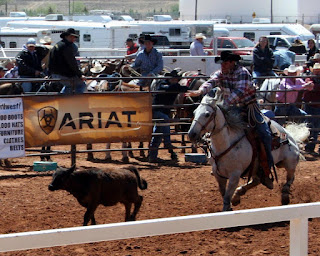
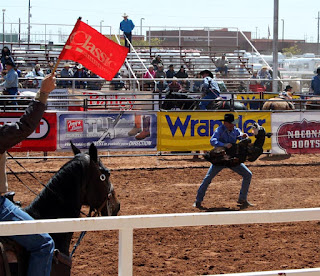
We saw our first calf roping down at the Curry County Fairgrounds on the same weekend as the Chuck Wagon Cook-Off, back on May 2-4. I kind of embarrassed myself by clapping wildly when the first fellow I saw finished tying up his calf. In the middle of my cheering I suddenly realized that no one else up in the stands was paying any attention at all. It was just another calf roping to them; leaving behind for the moment any sympathy I might be having for the calf's feelings, it was an incredible feat of amazing horse and cowboy athletism to me.


When the calf is released, the cowboy takes off after him, lassoes him and leaps off the right-hand side of his horse in an astounding airborne move. The well-trained roping horse holds the rope taut so the calf can’t get away while the cowboy leans over the 200-pound calf and grabs his legs and brings him to the ground. You can click on the above photo and look really carefully to see that the cowboy has a short rope in his teeth called a “piggin' string” that he uses to tie the calf’s feet together.


The whole thing is over in just a few seconds—the fastest times recorded have been in the 5.7 to 6.7 second range! This kind of roping is called “tie-down roping.” There is another kind of calf roping called “team roping” which I hope to see soon because, contrary to all possible predictions, I have become a rodeo fan.

Tuesday, May 6, 2008

Dutch Ovens

Fresh biscuits at the
Duke of the Dutch Oven Cook-off


Did you know that the Dutch oven is the State Cooking Pot for Utah? As a way to honor their pioneer forbearers, the Utah State Legislature named it so in 1997. Utah is home to the International Dutch Oven Society, the site of the World Championship Dutch Oven Cookoff , and is a place where Dutch oven usage is still widespread.

Learn all about cooking with a Dutch oven and get some recipes for the kind of food made by the cook on the trail—beans, meat, potatoes, sourdough biscuits, dump cake, and peach cobbler--on the Cowboy Showcase.

Thursday, September 20, 2007

Cowboys of the Canteloupe Corral


Time to paint the living room. Enough with those beige walls. This is New Mexico, after all, where colors are intense and seen in combinations that you might never imagine. When we lived in Las Cruces I learned that pink and orange and purple together make a wonderful combination. My color courage grew, and when we moved back to New England I planted hot red-purple-pink-orange flower colors side by side out in the garden, then took my newfound bravery to our interior walls.


Our red New Hampshire living room brought friends scurrying to have a look. They liked it but said that they would never have the courage to do the same to their walls. But I noticed that they smiled a lot in that room.


Now, in our new Clovis house, we have a red-orange kitchen and dining room. I can't claim to have done it--I probably wouldn't have been brave enough--but I love the results. It's a great place to be in.


So, now it's time to paint the living room. It's such a neutral place, though it has lots of texture--brick, wood, faux leather, and copper touches. It's a little kitschy, I'm afraid, with a cowboy theme featuring pictures of me as a four-year old "cowgirl" living in San Francisco. There are big boots and my little boots from way back then. There are some fake cowhide items. It's comfy and a good place to kick back and put your boots up. But it's all surrounded by those beige walls.


Well, I'm ready to make the change, and I just got back from the paint store with a bucket of paint in a shade that looks like the fresh canteloupe down at the Clovis Farmer's Market. Cowboys, saddle up!