Tuesday, March 29, 2011

Book Report: Mysteries of Medieval Ireland


I like my mysteries with a little "value added"--that is, I like to be learning a bit about an unfamiliar time and place while enjoying a good novel. These books, part of a series called the Burren Mysteries by Cora Harrison, are just about perfect as far as I am concerned.

They are set in the early 1500s on the Burren, on the western seaboard of Ireland. So far, I've learned about the stony fields there (look at the beautiful album of Burren photos on the Cora Harrison website to see what they look like); bits of the Gaelic language; a fair bit about Brehon--early Irish--law, which is very different from English law; and I have come to admire Mara, the female judge and heroine of the tales--I love the way her mind works!

Monday, March 28, 2011

Bike Ride: Las Cruces Flood Control Dam

The beginning of the ride, with Beez in the distance

Even though I understand the need for flood control in a place that can get a lot of its annual rainfall in two or three good storms, I am still fascinated by the fact that a great big earthen dam stretches across the desert city of Las Cruces. 

I checked out some of its statistics, found in this report

  • The dam can hold back 12,500 acre feet of water (one acre-foot being the amount required to cover one acre to a depth of one foot)
  • It's three miles long and up to 67 feet high
  • The crest of the dam is 20 feet wide and used by walkers, joggers, and bike riders

It's an interesting ride. Looking up toward the mountains, you see desert scenes. 


In the other direction, it's all urban with distant views of more mountains. That's Picacho Peak on the left. Our house in nestled in the rural area of the fertile river valley at its foot. 


Thursday, March 24, 2011

Yellow Skies Over Tularosa, for Skywatch


These were the skies over the Tularosa Basin as we drove back from a trip to eastern New Mexico a few weeks ago. For sky photos from all over the world, please visit Skywatch Friday.

Tuesday, March 22, 2011

The Cost of Vegetables


For two days I watched these farm workers with hoes make their way down each row in this field of newly-planted cabbage across the road from our place. There were at least three times as many workers as shown in this photo. They started at sunup each day and stopped work eight hours later when it was too hot to do any more.

That's an awful lot of man- and woman-hours just to grow cabbage, and this isn't counting the days of plowing--slow-moving tractors spend a lot of time grooming this field--and the planting and irrigating. Of course, there is still the cost of harvesting, processing, and transporting the cabbage to market.

This has given me a lot to think about whenever I look at the cost of vegetables.

Monday, March 21, 2011

Blue Neon Crosses

Our Lady of Health in the old Las Cruces Mesquite neighborhood is my favorite church to photograph.
The Mass is held in both English and Spanish


The colorful facade is so different from the more austere New England meetinghouses of my old town in New Hampshire


The crosses are outlined in blue neon, a beautiful (and so Southwestern) sight against the nighttime desert sky. You can get an idea of what they look like when lit here, in this photo taken at dusk.

Friday, March 18, 2011

Reaching Out: The Starfish Story (Again)

Leny (photo by Beez)


It's been a horrifying and difficult week. We've all agonized over the situation in Japan and tried to imagine that we might be able to make a difference, one of us at a time (see Becky's Blog: For Japan). We were haunted by the plight of a suffering little donkey and wondered if there was a way to free him (there was, and it happened!). We observed Adopt the Internet Day (see Let's Hear It For the Underdog), which featured so many deserving animals hoping for a home with love and safety.

At times like this, it helps me to remember The Starfish Story told in a speech by President Obama. I posted it on this blog after a visit to a kill shelter where so many were in need, and I could help only one.  Here it is once again, offered in the hope that we might find some strength in its words:


The Starfish Story

An old man walking along the beach at dawn sees a young man picking up the star fish and throwing them out to sea. "Why are you doing that?" The old man inquired. The young man explained that the starfish had been stranded on the beach by a receding tide and would soon die in the daytime sun. "But the beach goes on for miles," the old man said. "And there's so many! How can your effort make any difference?" The young man looked at the starfish in his hand and without hesitating threw it to safety in the sea. He looked up at the old man, smiled and said, "It will make a difference to that one."

Thursday, March 17, 2011

Dust to Dust Under Clear Blue Skies, for Skywatch


Adobe houses are made of mud. They need a certain amount of upkeep and care or they will return to the earth from whence they came. 

My house (not shown, but you can see it here) is made of adobe. I take care of it, keeping this place in mind. This abandoned and crumbling mud house is in a beautiful setting with trees and fields all around and wonderful mountain views. Once a place for a family's dreams, it is now a ruin melting back into the ground. 

For skies and scenes from all over the world, be sure to visit Skywatch Friday

Wednesday, March 16, 2011

Surprised by Joy*: A Story You Won't Want to Miss

I don't want anyone to miss this story of a little roping donkey who was stuck in an awful life of abuse, pain, and terror. I am telling you about this little guy because I know you will want to hear the happy ending. The news these past days has been so awful that it is wonderful to be grabbing for tissues to mop up tears of joy, instead of sorrow.

It begins with this March 3rd post on the blog, Morning Bray Farm, where we first were introduced to a forgotten little donkey: Agony. Everyone who read about him was haunted by his sad plight, and many tried to come up with a solution for him. (Be sure to read all the comments on each post).

Then came wonderful news on March 14th: He Will Never Be Roped Again. It was a short post, just to let readers know he had been rescued.

Today's post gave the details of how Patrick came home to a safe and loving place.

It gets even better. Two more donkey bloggers (betcha didn't know there was such a thing) from New Mexico and Oregon came to Justina's aid at Morning Bray Farm to help out when she had to be away at work. You can read their accounts and see lots more photos of Patrick's first interactions with caring humans.

They are (and I was kidding with the "donkey blogger" label--you'll see that they blog about way more):

Linda of the 7MSN Ranch: A Lucky Donkey Finds His Pot of Gold

Danni of On the Way to Critter Farm: I Saw Magic Happen Today

There! In a world filled with tragic news from Japan, I can offer you no more heartwarming story. So get out the box of tissues and prepare for joy.

Then we can get back to figuring out how to help the suffering people in Japan: See 2011 Japanese Earthquake and Tsunami for crisis response resources.

*****

*Surprised by Joy is the title of a book by C.S. Lewis; I have always loved the phrase

Tuesday, March 15, 2011

Let's Hear It For the Underdog


This is Weetzie. 
I found her at a kill shelter; it was to have been her last day. 
After seeing her crouched in her cage, I promised her that I would take her home. 
I had to leave her for a few minutes to fill out the paperwork, but I kept my promise and went back to the cage. 

When I reached for her, she growled at me

I'll always be glad that I didn't let that change my mind. 
The attendant lifted her into my arms and I took her home, wrapped in a little blanket. I bathed her and wrapped her in a towel and sat with her for a while in the rocking chair. 

She is a loving member of our family and we can't imagine not having her with us. 

She still growls when she is picked up and when she first wakes up in the morning.
We have had so many laughs with her, because those growls are so at odds with her loving nature and sweet personality. 

I guess I am asking you to give these abandoned shelter dogs a chance. 
Scary things have happened to them, and sometimes they just need a little peace and quiet to show you who they are. 


Petfinder Adopt-the-Internet Day

Monday, March 14, 2011

The City Goes Green With Goats

Goats doing what goats do
The City of Las Cruces Public Works Dept. recently decided to try out goats for weed control at a local drainage pond. I was lucky to get this shot, as the goats had just about completed their job of ridding the area of tall weeds that were acting as a breeding ground for mosquitoes. A few days later, the herd was moved elsewhere to help out with another project.

The neighborhood where the pond is located is called "Chiva Town" for the goats that were once commonly kept in yards nearby. You can read an article about this "green" weed control project in the El Paso Times.

Thursday, March 10, 2011

Dark Skies for Skywatch


February 2011: Dark skies, New Mexico style

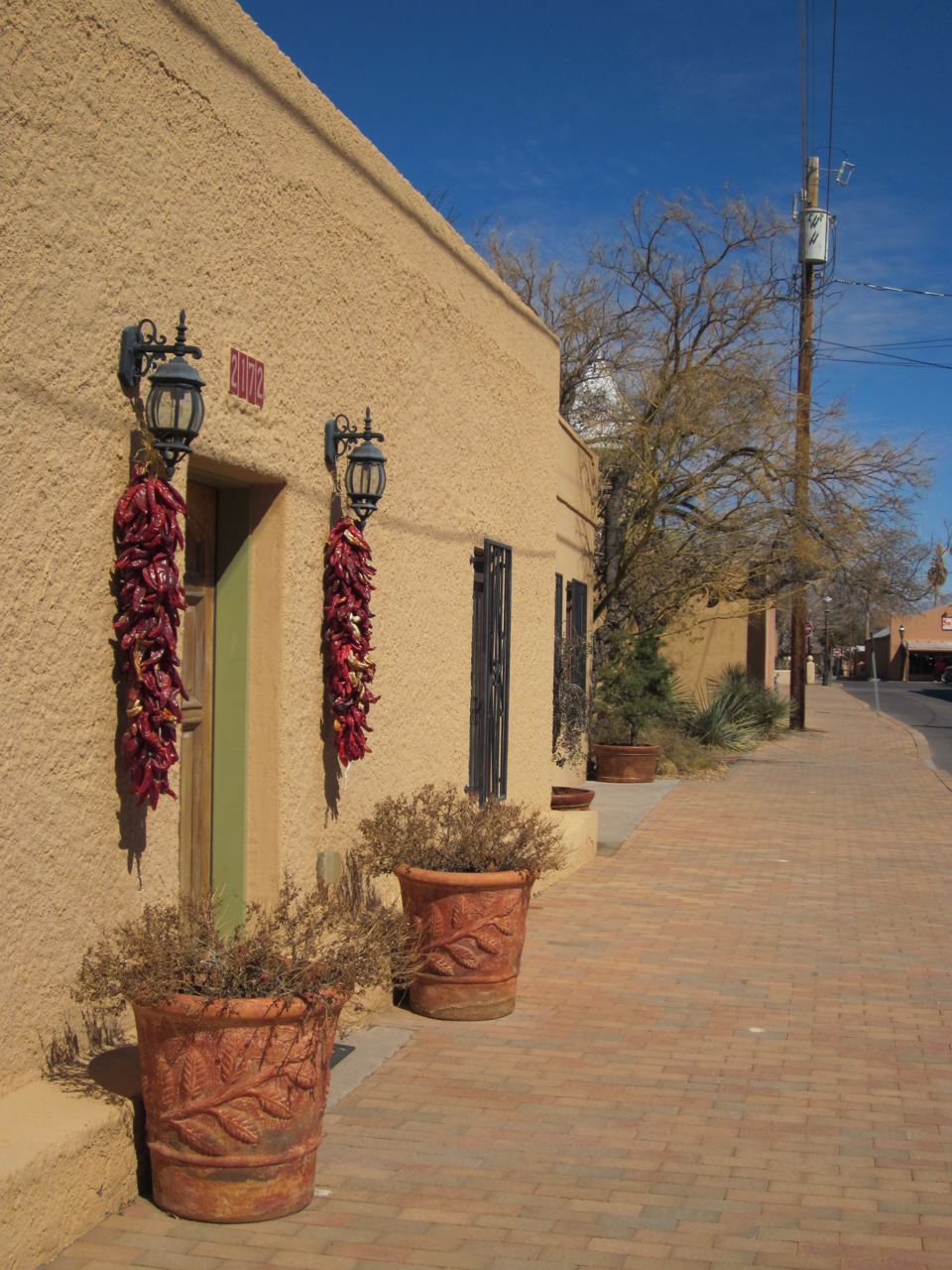
Nothing says Old Mesilla like the texture of thick adobe walls, dried strings of red chiles, old brick sidewalks, and that dark blue New Mexican sky. For skies of every color all around the world, please visit Skywatch Friday.

Wednesday, March 9, 2011

My Math Class (No, Really!)

When we lived in New Hampshire, I was fascinated by the Monadnock Summer Lyceum, a series of public lectures and performances for adults (you can read about the lyceum movement in the U.S. here). The lectures sounded so cultured and like such a grown-up thing to do, but they were held in far-off Peterborough on the other side of the state so I was never able to attend.


Now that we are retired and living in Las Cruces, we have discovered the Academy for Learning in Retirement and I believe that I have found my lyceum at last. 


Our first series of lectures is called The Beauty of Mathematics, Old and New. I was a little worried about being able to keep up, but have done pretty well so far. Well, with one exception--the first lecture was on symmetry in the art of M.C. Escher and everything was going swimmingly until the professor uttered the word polynomial and I instantly drifted off in that embarrassing head-lurching way that almost gives you whiplash. Beez poked me back to consciousness and I was hanging on by a thread until the word quadratic sent me bobbing and weaving again. 


The second lecture was on Fermat's Last Theorem and the lecturer really brought the subject to life. We learned about Sophie Germain (1776-1831), one of the first female mathematical thinkers and researchers. Sophie proposed a plan to solve Fermat's problem, and the professor guided us through the first few steps in a way we could all understand. I loved this lecture--in fact, I wanted to be Sophie and I itched for stacks of clean paper, sharpened pencils, and an infinite amount of time to work out mathematical proofs. 


I later came across a review for a book called Yearning for the Impossible; The Surprising Truths of Mathematics, by John Stillwell. The review stated, in part, "Stillwell weaves historical details into his writing seamlessly, helping to give the reader the true feeling that mathematics is more than just a bunch of people playing games with symbols, but rather a rich and rewarding intellectual endeavor important to the human enterprise."


Now, that is exactly how I felt after the excellent lecture on Fermat and Germain. Not bad for an English major (me)--I tell you, that professor is something else!

Tuesday, March 8, 2011

New Discovery: Dogs Can Listen, Appreciate Science, and Salivate Concurrently

As you might expect, our dogs are quite interested in matters pertaining to veterinary science. Beez was recently reading an article to them from The Economist (Hot Spots; How Changing Farming Habits Threaten Human Health) about livestock-to-human transmission of diseases, and they were absolutely riveted by his description of Crimean-Congo haemorrhagic fever. 


... Or were they?

Hint: Look closely (click to enlarge) and you will see the plate of bread and cheese balanced on Beez's chest.
Everyone in our house can multitask, even the recently-retired guy.

Monday, March 7, 2011

Blue

Blue gates in Old Mesilla
Around here in southern New Mexico, it's one of those things "everybody knows"--that the blue often painted around the openings into houses is there either to actually repel evil, or because the homeowner has heard that this is an old belief.

I checked around and came up with a few links to interesting information (and some wonderful photos) about blue paint on doors, windows, and gates.

Thursday, March 3, 2011

Picacho Gate, for Skywatch

Enlarge by clicking to see the different shades of blue

Blue New Mexican skies and a view of Picacho Peak, framed by an adobe gate at the Mesilla Valley Bosque State Park in Las Cruces, New Mexico.

For views of skies from all over the world, please visit Skywatch Friday.

Wednesday, March 2, 2011

Vayan con Dios


Red chiles and Our Lady of Guadalupe: Courtyard scene in Mesilla, New Mexico

Tuesday, March 1, 2011

Cross and Thorns

As I mentioned yesterday in the post titled Fixer, many of the more tender cacti around town have been killed off by our spell of bitter weather this winter. We should have known better, pushing the planting zones as we do with plants that are possibly too delicate for our temperature extremes. Now we are all paying for our hubris with piles of dead and rotting plants around our yards.

However, this particular form of prickly pear has made it through. I found this example in Mesilla, but I have a smaller version in my very own yard. We all bear scars from planting it and I don't think anything will ever hurt it as much as it manages to hurt us.

Too mean to die


Every once in a while, we come across other plants that made it through, perhaps because they were sheltered against a south-facing wall, or maybe because they were watched over by some other form of protection. I love this one by a blue gate in Mesilla.


Monday, February 28, 2011

Fixer


We spent some time wandering the back calles (streets) of the nearby village of Mesilla the other day. Coming across this worn old adobe gate, we mourned the terrible damage done to the prickly pear plants by our recent spell of below freezing weather. As you can tell, these are plants that have been growing at this site for a good many years through all kinds of winters, but the bitter cold of this past month has done them in.

If you are able to do adobe repair and reconstruction, the house is in the same shape as the gate--a fixer, for sure, but located in a lovely old back lane of a beautiful town.

Friday, February 25, 2011

Orange House, War Zone


On a recent weekend, 53 people were killed in Juarez, Mexico, just across the border from El Paso, Texas. The murders were part of the ongoing violence between rival drug cartels--a Dec. 15, 2010 CBS article reported over 3000 people killed in 2010, with almost 7400 killed in the last three years. A quote from that article: "More than 28,000 people have died throughout Mexico in the four years since President Felipe Calderon launched an offensive against drug cartels when he took office in December 2006." 

When we go down to the El Paso Airport, we usually stay away from I-10, which parallels the border along the Rio Grande for some miles. Although El Paso is one of the safest cities in the U.S., Ciudad Juarez is one of the most dangerous in the world. Stray bullets have been known to hit buildings and cars on our side of the border, which lies just down the slope in the foreground of this photo. 

I shot this through our [dog-drooly] car window as we hurried past this place where people live in poverty and unimaginable danger, day in and day out. In spite of the poor quality of the photo, I thought it was important to show you this scene.

Thursday, February 24, 2011

Why I Don't Live in El Paso, for Skywatch


I'm sure there are pretty parts of El Paso, but this is what I see when we travel through: Blue skies, yes; but too many cars, too many people, and too much speed and noise. 

I-10 heading north

Looking toward downtown El Paso with poor, war-torn Juarez, Mexico in the distance

I like a little more peace and space around me: A little more solitude, as you can see from the header photo of Beez at White Sands (click here if the header photo has been changed) and from the photo below, which was taken not too far from where we live.

Looking across wetlands at the Mesilla Valley Bosque State Park toward the Organ Mountains. We saw a coyote out for a ramble on the day we were there

To see both urban and rural skies from all around the world, please visit Skywatch Friday.

Monday, February 21, 2011

Peaceable Kingdom

Pity the poor blogger's husband--he can't just slip off and have a retired guy's little afternoon nap with a few of his friends without having it documented and published here.

Click twice to enlarge

But they were just all so darned cute hanging out together in the sun that I couldn't resist taking this photo. The human is Beez; the dogs are Weetzie, Leny, Little Pete (getting some napping directions), and Emma; and the cats are Gracie and Cody-Ko. 

So goes the retirement--just one task after another...

Thursday, February 17, 2011

Adapting a Fair Isle Motif

I came across a star motif knit into a pair of gorgeous hand spun mittens and wanted to use something similar in one of the little Knit for Kids sweaters that I was planning. A search around the internet resulted in this Spring Star pattern, found as part of a Wee Fair Isle Sweater Project (which I can no longer find online as of 7 Oct 2017).

It was meant to be done across a multiple of 26 stitches, but my pattern called for 69 stitches for the front and 69 for the back. Although you knitters most likely know all about this stuff, I was delighted when I figured out a way to repeat the motif and center it in the number of stitches I was allowed. 

First, I printed out a copy of the pattern. I planned to use both "Spring Star" and "Spring Clover" designs in my sweater.


Then I made several more copies and cut them up, trying them together this way and that, folding under and thus leaving out sections of the pattern, and even (gasp) turning some sections upside down. When I had something that I could center on my sweater front, I taped the whole thing together and attached it to my little magnetic board--all ready to knit!

For each row, I just had to repeat the pattern shown below twice, since I was knitting in the round and wanted the pattern on both the front and back of the sweater. I had to leave a few stitches in plain white at each of the sides, but that didn't affect the overall look. I was just thankful that the pattern appeared centered on both sides. 


Here is the completed sweater (click to enlarge, if you wish). You will see that I am working my way through my yarn stash and trying to use up a variety of colors before buying any more. 

Tuesday, February 15, 2011

Adopt a Pet!

Rescued dogs come in all shapes and sizes (and facial expressions)


Did you know that approximately 4 million adoptable dogs & cats are killed each year due mainly to overpopulation? Did you know that 25-30% of dogs for adoption in animal shelters are purebred? The other 70-75%, of course, are lovable, wonderful mixed-breed pets, just waiting for a chance to be your perfect new friend.
In an effort to help people make good choices when they adopt a dog or cat, many humane societies, SPCAs and pet rescues provide adoption counseling to help match you up with a pet for adoption.
If you have your heart set on a specific breed, before you check out a dog breeder or pet store, why not adopt a pet from a breed rescue organization? Breed rescues are groups that specialize in a particular breed of dog or cat.
Don't be fooled into thinking that animal shelters and pet rescues are filled with dog or cats that were discarded because they're "bad". Shelter pets for adoption are wonderful companions who became the victims of family tragedy, unlucky circumstances or irresponsible owners.
Did you know that many backyard dog breeders and pet stores who supply the majority of purebreds simply are selling inbred pets without care for preventing genetic problems? Mixed breed pets have less inbreeding, generally less inherited genetic disease, and therefore overall lower vet bills and happier pets! And the best place to find a mixed breed dog or cat is at an SPCA, a humane society or an animal shelter. (from Adopt a Pet.com)


Monday, February 14, 2011

Craig Childs on National Public Radio

I've been reading a lot of Craig Childs lately--House of Rain, The Secret Knowledge of Water, and now Finders Keepers; A Tale of Archaeological Plunder and Obsession--so I thought I'd gather up some links to his own website, some quotes, and his audio interviews on National Public Radio.*


Tracking a Vanished Civilization in the Southwest
About the book House of Rain
" ...This is where the Anasazi lived. Their ruins are everywhere out here, the remains of a great Neolithic civilization. Single buildings the size of the base of the Sears Tower. Huge, round ceremonial chambers with 90-ton ceilings. This was a landscape of monuments... The Anasazi lived here for more than 1,000 years. Then, within a single generation, they were gone. Between 1275 and 1300 A.D., they stopped building entirely, and the land was left empty.


Soul of Nowhere; Author Craig Childs Journeys into the Wilds of the Desert
"There are some landscapes in the desert Southwest where Craig Childs will walk for a month without maps, or even a compass. Maps often do no good in these wild reaches, the author and explorer says."


Archaeology: Not as Dry and Dusty as You Think
About the book, Finders Keepers: A Tale of Archaeological Plunder and Obsession
"...Childs says it can be difficult to strike the right balance between expanding archaeological knowledge and preserving historical sites. 'I've worked on quite a few archaeological excavations where you're down in a trench, digging with a trowel, and wondering, ‘What on earth am I doing, digging through some dead person's belongings?' "


The Civilizations Buried Beneath Us
"Once workers tore up a Phoenix parking lot and found nearly two hundred ancient human burial sites under it. Ceramic jars and finely crafted offerings were tucked among the dead, who rested beneath parked cars for decades. After hearing about that, I look at parking lots differently. I imagine the asphalt like a glass-bottomed boat. Skulls and bones and the blueprints of villages float below."


The Coyote I Didn't See
About the book The Animal Dialogues: Uncommon Encounters in the Wild
"There was a faint shape in the snow, curved as an eggshell. It had been left by a sleeping coyote. I took off my glove and touched the slight glaze of ice from its body heat. It had lain here maybe three hours earlier. Sometimes you can see more of an animal's life in its tracks than face to face."


Craig Childs' own website: http://www.houseofrain.com/
Audio, photographs, guides to the books


*****
* National Public Radio is in danger of losing its funding. Please consider signing a petition to let Congress know that you support public broadcasting. 

Thursday, February 10, 2011

Gray Skies = Excitement! For Skywatch

I put together this Skywatch post before our recent stretch of below-zero weather. I'm not so excited to have snow now. But I did want to show you that we get occasional snowstorms out here in the Chihuahuan Desert. 


There, I hope you've seen enough, because I am not planning for us to have any more snowstorms. Or freezing weather. Or broken water pipes

For sky and weather photos from all around the world, be sure to visit Skywatch Friday

Tuesday, February 8, 2011

We Get Running Water and Ponder the Lives of Those Who Never Had It

Well, now that I've depressed us all with that photo of the inside of our torn-apart hot water heater shed, I'm happy to report that all is back in order today--neat, tidy, and shipshape--and looking like nothing ever happened. It's too dark out still for me to get a photo of the little shed, all restored and looking much better, but it is so. We have water, blessed running water. We have it in hot, and we have it in cold. We don't have any yet to the back bathroom (this house has multiple additions, built on over time, and that back bathroom is pretty darned far from where I sit in the original front room of the oldest part of the adobe), but that will come once the plumber and his good men have made sure all their customers have running water of one sort or another.


In the meantime, I've been reading a book about people who lived in far more ancient adobe structures in this part of the world with no running water at all. The book is called House of Rain, and is written by Craig Childs, the wonderful Southwest nature writer.  According to the back flap, he is a "naturalist, adventurer, desert ecologist, and frequent contributor to National Public Radio's Morning Edition."

The Ancient Puebloans, formerly called the Anasazi, disappeared from their elaborate cultural centers in the 14th century--leaving their cities pretty much intact, with the dishes still on the table, so to speak. Where they went has always been a great mystery in this part of the world, and Childs sets out to find what happened. Childs journeys through the Four Corners area of New Mexico, Arizona, Utah, and Colorado; then down into northern Mexico, tracking this vanished civilization.

In following the trail of these "lost" people, he makes the reader aware of the abundant archeological record that they left behind, just under the surface of our own towns, cities, and agricultural fields. I have the sense now that every rise in the landscape must hold some key to the mystery, some other piece of this old civilization's ruins. It's a bit like when I was a child and convinced that every rock I found was a geode, full of wonders within.

We have personally experienced this link with ancient times most strongly at Pecos National Historical Park, where we were stunned to realize that the place was littered with artifacts. What we had first assumed were pieces of rock alongside the paths were, when examined more closely, actually thousands and thousands of pieces of ancient pottery sticking up out of the ground.

I also came away from reading this book with a feeling of admiration--real awe, to be exact--at how today's Pueblo peoples have continued their culture and kept their secrets in the middle of a modern American society. We still don't know what happens down in their kivas, and I don't think we ever will. After all, as Childs tells us: It was none of my business, really, the private rites of another civilization.... These were someone else's secrets, not mine.

Monday, February 7, 2011

The Las Cruces Report: Early February and a Deep Freeze, Part 2

In our recent sub-zero weather here in New Mexico, our pipes froze last Wednesday and thawed on Friday. That was when we knew we had a broken pipe and got the water shut off at the main. Here it is Monday now, and we are still without running water.

Oh, we've seen our wonderful plumber, Paul, who is still his handsome, cheerful self, in spite of being absolutely exhausted from dashing from house to house on his list, deciding who has the worst water/pipe issues and which ones can be easily and quickly repaired. While he was here, he disconnected and pulled out our hot water heater and located the problem pipe. Sadly, it is inside of a wall behind our refrigerator. Because our job will take longer than most, Paul asked for our patience and will get back when he can to start ripping out the interior wall.

This really has a Third World look to it, don't you think? Who has a hot water heater located outside? The heater is now in the backyard (yes, even more charming) and the outdoor shed walls and pipes have been ripped about in the search for the leaking pipe

In the meantime, we've learned a few things about our modern dependence on running water. Although, as desert dwellers, we are always careful not to waste a drop, we find that we take for granted flushing toilets, washing hands, shampooing hair, taking showers, and doing laundry. On the other hand, we've discovered just how little water we can get by with from day to day, especially after the local grocery store started running out of drinking water. 

We also found just how hard it is to clean up a kitchen full of the pots and pans used to prepare Beez's signature white lasagna, which he considers a "must-have" for any Super Bowl party. Yes--we decided to go ahead with our party plans, and hosted a wonderful group of friends who kindly carried in their own water for flushing, and brought us drinking water, too!

They were from the parts of the city that still had running water. Even though water was not a problem at their houses, they had all experienced rolling blackouts with no electricity for several hours at a time, as well as the fear of no heat in freezing temperatures, due to the state-wide shortage of natural gas brought on by the increased demands. That was a very scary part of our recent brush with an arctic storm--our utility companies just weren't prepared to handle unprecedented energy demands and their own instrumentation apparently froze up. 

There is a lot of anger at the electric company--after all, people had tvs and heat pumps blow with the electricity surging off and on. While I don't think the company is to blame for the results of the kind of weather that hasn't been seen in our area for 60 or 70 years, I am very worried that with global warming adding more moisture to the atmosphere (as I understand it) that these kinds of winter "aberrations" will become more common. 

Saturday, February 5, 2011

The Las Cruces Report: Early February and a Deep Freeze

Newspaper photo: Ice from somebody's broken pipe (Robin Zielinski/Sun-News)


The weather is the big news here, just as it has been nearly everywhere else this winter. According to the Sun-News, the temps were below freezing for over 91 hours straight over the last few days; that's some kind of new record. Here in the North Valley, we got down to -1 F.  At the 7MSN Ranch nearer to the center of the state and at a higher elevation, temps got as far down as 27 below!

Here in New Mexico's southern desert, we aren't prepared for this kind of weather, EVER. Our hot water heater is located outside on the north side of the house, and is housed in a small shed-like jog. You can imagine how well that works out in sustained, near-zero weather.

Yep, our pipes froze and we're pretty embarrassed. As New Englanders, we know how to prevent this kind of thing, but we were too snug and warm in bed to get up and deal with the issue. In our own defense, pipes have been bursting all over. The whole darned city is a mess.

We babysat our frozen pipes until things thawed out yesterday and the open faucets began to run free. Then there was that ominous sound of running water inside the wall and Beez took off for the main water shut off. That was frozen, and when I saw him heading out the door with a sledge hammer, I headed him off and called the water company before things got even worse. They managed to fit us into their gigantic list of people with emergencies and were outside within minutes because one of the water guys happened to be passing by.

So, here we are in the sunny Southwest with no running water. It's a clear day, and the temps will be above freezing--we'll even see 60 on Tuesday. We're not dealing with mountains of snow like our old neighbors back east. We have electricity and heat (more about that in the next post), so we can't really complain. But no water equals no bathroom facilities, which means we probably won't be hosting our first annual Super Bowl party tomorrow.

The plumber, who has always been on speed dial since we moved here, is so backed up that we have no idea when he'll be here to repair the pipes. There are stories of weary plumbers working almost around the clock.

Will our walls have to be ripped out? Will the repairs take up the whole carpet replacement budget? We were so hoping to get the next phase of the floor project done by spring. It looks like that is a dream deferred...

Tuesday, February 1, 2011

Why We Won't Eat Veggies

We love the idea of eating fresh, organically grown vegetables and fruits. However, we don't always do what we should, and house guests in the past have asked where we keep the vegetables and do we, in fact, ever serve any with meals?

Thanks to an article (no longer available online, I checked) published in the local newspaper, we have recently discovered that we can buy a weekly harvest box directly from the growers in Mesilla. [Later note: Some of the produce comes from their "partner farms"]. We are pleased to report that it contains an amount of fresh produce that we can actually eat in a week. No more strange, soggy unknown masses down there in the vegetable drawer--this produce is so lovely that we actually want to eat it, and we are learning to eat fresh fruit for snacks instead of cookies. Really.

The contents of last week's box--kiwis, roasted chile peppers, mushrooms, baby spinach, etc. 

Do we get stuff we have never tried? Yes--how about collards and green cabbage! I discovered that collard greens don't have to be cooked forever with fatback--they can be steamed. I also found that green cabbage can be made into a lovely vegetable stew that smells pretty darned good while it's cooking.

However, I think it's an insult to label this good stuff with that modern slang word--"veggies." It's entirely too familiar a form of address. These dignified and beautiful vegetables deserve our respect, and I insist on calling them by their proper names. "Veggies," indeed!

*****
Harvest boxes ready to pick up on Friday afternoon. Nice farm guy, too!

You might want to spend some time visiting the Los Poblanos website. Here is the link for the Las Cruces page. You can also read about how the Los Poblanos Ranch got its start